
Laboratory Service
Sectors of Laboratory Service
- Index & Classification Testing
- Strength & Compressibility Testing
- Compaction & Subgrade Evaluation
- Concrete & Masonry Lab
- Aggregates Lab
- Structural Steel & Reinforcement
- +(256) 772 - 507696
- info@veritaslabs.com
- Head Office: Kyambogo Upper Estate - Nakawa Division, Kampala
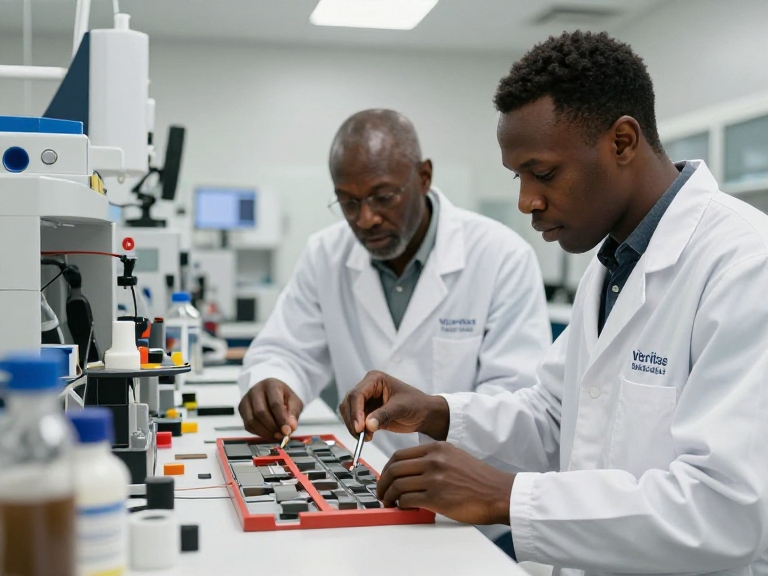
LABORATORY SERVICE OVERVIEW
As a professional laboratory our framework operates across three distinct phases of a project lifecycle:
Investigation & Baseline Characterization: Analyzing natural materials (such as raw soil, rock formations, or water sources) during the pre-construction phase to determine their inherent engineering properties.
Quality Control & Compliance Testing: Routinely testing manufacturing batches or site samples (like structural concrete mixes, asphalt, or high-yield rebar) during active construction to confirm they meet minimum safety thresholds.
Troubleshooting & Forensic Engineering: Utilizing specialized diagnostic tools—including non-destructive testing (NDT) or structural core extraction—to investigate structural anomalies or material failures in existing infrastructure.
Details
As a high-performing laboratory we relies on a rigorous operational system to ensure our results are legally defensible and scientifically accurate.
Standardization: All procedures are strictly bound to international test methodologies—such as ASTM (American Society for Testing and Materials) or BS EN (British Standards / European Norms)—to eliminate variance and guarantee repeatable results.
Equipment Calibration: Testing hardware (such as hydraulic compression presses, triaxial cells, and drying ovens) must undergo routine, traceable calibration to verified reference standards.
Personnel Competency: Testing must be performed and verified by certified laboratory technicians and materials engineers who possess deep technical knowledge of material behaviors under stress.
Data Integrity & Traceability: Chain-of-custody protocols track every sample from initial field extraction, through laboratory curing and testing, to the final signed engineering report.